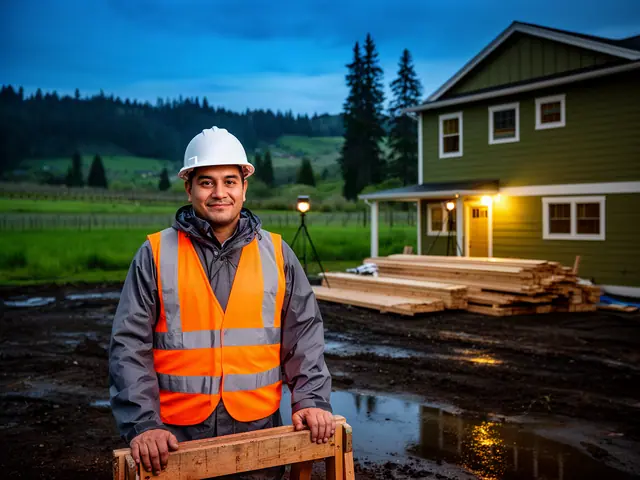
Mintreach Finance, an Albany, Oregon small-business funding service, explains financing for Linn County, OR contractors: construction equipment, inventory funding for builders, HVAC lines of credit, and plumbing working capital requirements, plans and loans. County construction counts, specialty-trade figures and residential permit totals from 2023 to 2025 anchor the sections.
At a glance
- Construction employers, Linn County, OR (2023)
432
- Construction businesses without paid employees (2024)
613
- New residential units permitted, 2025
189
Linn County, OR Construction Counts and Residential Permits, 2023 to 2025
| Business type | Employers (CBP 2023) | Employees | Annual payroll | Fewer than 5 employees | No paid employees (NES 2024) |
|---|---|---|---|---|---|
| Residential building construction | 137 | 405 | $16,852,000 | 80.3% | 214 |
| Nonresidential building construction | 19 | 225 | $17,734,000 | 31.6% | 23 |
| Plumbing, heating and AC contractors | 45 | 418 | $30,964,000 | 53.3% | 19 |
| Electrical contractors | 29 | 455 | $37,924,000 | 31.0% | 22 |
| Roofing contractors | 18 | 229 | $13,710,000 | 44.4% | not published |
| Building finishing contractors | 57 | 326 | $16,748,000 | 63.2% | 101 |
| Other specialty trade contractors | 57 | 465 | $36,090,000 | 56.1% | 158 |
The Building Permits Survey counted 377 new residential units authorized in Linn County, OR in 2023, 309 in 2024 and 189 in 2025, of which 140 were single-family (Census Bureau, Building Permits Survey). The survey counts new homes only, not remodels or commercial work, so it is one measure of residential building activity, not of all construction. Nonemployer Statistics reports roofers only inside foundation, structure and building exterior contractors (NAICS 2381), which counted 57 businesses without paid employees in the county in 2024, so the roofing row shows no nonemployer figure.
Construction Equipment Financing for Linn County, OR Site and Framing Crews
Excavators, skid steers, telehandlers and dump trucks are financed against the machine, with hours, condition and the contracts it serves in the file. Residential building contractors had 137 employer establishments in Linn County, OR in 2023, 80.3% with fewer than five employees (Census Bureau, County Business Patterns 2023); a small crew buying its first excavator has the machine and its job history to show. See equipment financing and the article on where contractors finance machines.
Inventory Funding for Builders Holding Lumber and Fixtures in Albany, OR
Builders buy lumber, windows and fixtures before a phase is billed. Materials going into a customer's building are not resale stock, so inventory financing does not fit them; the purchase is funded instead as working capital or a credit line draw tied to the job. Invented example: an invented $38,000 lumber package for a framing phase, drawn on a line of credit and repaid from the phase draw, costs interest only for the invented weeks it is out.
HVAC Business Line of Credit for Linn County, OR Mechanical Contractors
Plumbing, heating and AC contractors had 45 employer establishments with 418 employees in Linn County, OR in 2023 (Census Bureau, County Business Patterns 2023). An HVAC company buys equipment for each install, from furnaces to heat pumps, and is paid when the job is finished and invoiced. A line drawn for the equipment and repaid from the invoice follows that cycle; the service vans and diagnostic tools are long-lived purchases suited to equipment financing.
Plumbing Business Working Capital Requirements an Albany, OR Plumber Can Expect
- Business bank statements showing deposits and low balances
- A receivables aging report, including retainage held by general contractors
- A list of open jobs with contract values, amounts billed and expected payment dates
- Every loan, lease and advance already on the books, with its monthly payment
- Current standing with the state contractor board and the Oregon Secretary of State
A Plumbing Business Working Capital Plan Built Around Draw Dates and Retainage
Invented example: a plumbing contractor holds an invented $410,000 subcontract, has billed an invented 60% of it, and the general contractor withholds an invented 5% retainage. The invented retainage held so far is $12,300 (our arithmetic), cash earned but not yet paid. A working capital plan lists every such amount by job with its expected release date, then sizes any borrowing to the gap that remains after the next draws.
Buying an Existing Linn County, OR Contracting Business
Buying a contracting company means buying its trucks, tools and equipment, its open contracts and its standing with customers and general contractors. A partner reads the seller's tax returns, a list of equipment with titles and liens, the backlog of signed work, and whether the contractor license and bonding can carry over or must be replaced. Other specialty trade contractors and building finishing contractors each had 57 employer establishments in Linn County, OR in 2023 (Census Bureau, County Business Patterns 2023).
The purchase itself is a term loan request; machines bought at the same time can be split out into equipment financing. A buyer stepping into a contracting firm also inherits its crews and its customers' payment habits, so a payment history by customer belongs in the file alongside the backlog.
Plumbing Business Working Capital Loans or a Line: Choosing for a Linn County, OR Shop
A single large job with a known end suits a short working capital loan with a fixed end date. Overlapping jobs, with draws arriving at different times, suit a line. Buying an existing plumbing or HVAC company is a term loan request, with the trucks and tools as part of the collateral and the service contracts as part of the value.
Landscaping, logging and machine shops have their own notes on the industries page, and the full sector table is on the Albany, OR data page.
By Mintreach Finance · Updated